

Simply Piano's Silent Symphony: How an App is Composing a Billion-Dollar Music Empire

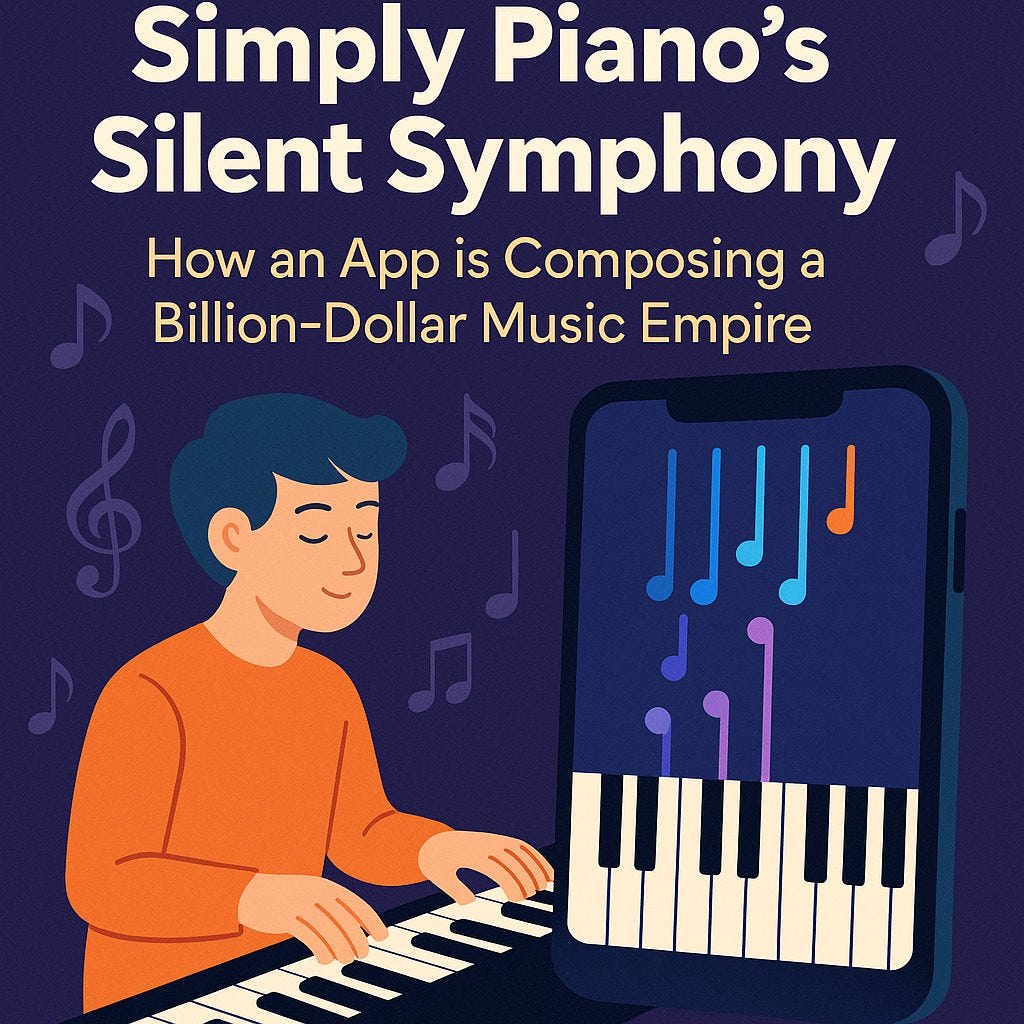
Remember the childhood dream of playing piano? For generations, it was synonymous with dusty sheet music, screeching metronomes, and the stern gaze of a weekly teacher. It was a marathon of discipline where the finish line, playing a beautiful song, felt years away.
Then came Simply Piano.
The brightly colored app promised a revolution: “Play your favorite songs in weeks.” No teacher, no schedule, no pressure. Just you, your phone, and the instant gratification of making music. It worked. With over 10 million downloads and a parent company (JoyTunes) valued at $1.2 billion, Simply Piano didn’t just disrupt music education, it rewrote the score.
But is it teaching music, or just training users to play a high-tech game of Simon? Let’s decode the silent symphony of gamification, data, and psychological hooks that made Simply Piano a hit, and ask whether it’s building musicians or just masterful subscribers.
1. The Gamification Genius: Candy Crush for Chopin
Simply Piano’s first masterstroke is its onboarding. Unlike traditional lessons that begin with the drudgery of scales and note-reading, the app gets you playing the melody of Jingle Bells or Fur Elise within minutes. This exploits the progress principle, the powerful human bias where small, immediate wins create the momentum for long-term effort.
The core loop is fiendishly addictive:
The Microphone as Judge: The app “listens” to you play via your device’s microphone, providing instant, non-judgmental feedback. It’s the killer feature. Contrast this with a weekly lesson where mistakes fester for days, laden with anxiety.
The Addictive UI: The interface is a dopamine drip-feed. You don’t read sheet music; you follow descending, color-coded bars that land on a digital keyboard. It’s a rhythm game, not a literacy test.
The Reward Engine: Streaks, experience points (XP), daily goals, and unlockable songs. This is the exact same operant conditioning that powers Duolingo and fitness apps. Users aren’t just learning; they’re leveling up.
The Data: User retention for Simply Piano is 2.5x higher than the average edtech app. They haven’t just built a teaching tool; they’ve built a habit.
2. The Business Model: Monetizing the Dream of a More Interesting You
Simply Piano is a freemium engine perfected. The app is free to download and offers a surprisingly generous taste of its content. The paywall hits precisely at the moment of peak addiction, when you’ve mastered a few songs and are hungry for more.
At approximately $120/year, it’s positioned as a no-brainer. It’s cheaper than two months of traditional lessons in most cities, making the decision feel less like a financial commitment and more like an exciting subscription to a better, more artistic self.
This model has fueled staggering growth. JoyTunes, Simply Piano’s parent company, generates an estimated $200 million in annual revenue. They aren’t selling piano lessons; they’re selling a low-friction identity upgrade.
3. The Psychological Playbook: The Illusion of Progress
Simply Piano expertly targets the adult learner’s psyche. It redefines what it means to “play” the piano. The app focuses overwhelmingly on playing melodies with the right hand, often simplifying rhythm and neglecting the left-hand harmony entirely. You feel like you’re playing a complex piece, even though you’re only performing a fraction of it.
This creates a powerful illusion of progress. Beating a level feels identical to mastering a skill. But does translating colored bars on a screen to keys equate to musical literacy?
The app’s curriculum is a mile wide and an inch deep, focused on pop hits and recognizable classics. This is a strategic choice: it maximizes engagement by catering to short-term desires, but it may sacrifice the foundational technique required for long-term, independent musicianship.
4. The Critics’ Chorus: The Limits of an Algorithmic Maestro
For all its success, Simply Piano has a glaring blind spot: it cannot teach nuance.
The Sheet Music Crutch: The app’s proprietary scrolling note system is a gilded cage. Many advanced users report being functionally illiterate when presented with traditional sheet music. They never learned to read the language; they just learned to follow one app’s translation.
The Bad Habit Factory: The app only cares if you hit the right note at roughly the right time. It can’t see a slouched posture, a stiff wrist, or flat fingers. It can’t hear the difference between a pounding, harsh tone and a gentle, expressive one. These bad habits, ingrained over hundreds of hours, can be incredibly difficult for a real teacher to correct later.
The “Three-Chord Wonder” Trap: The focus on replication over understanding can create players who can perform but not create. They lack the theoretical underpinnings to improvise, compose, or even sight-read a simple piece outside the app.
As one piano pedagogue noted, “Simply Piano is an excellent gateway drug for motivation, but it is not the main course. True musicianship requires a human teacher to guide the intangible elements of expression and artistry.”
5. The Big Picture: The Hybrid Future of Learning
Despite its flaws, Simply Piano’s impact is overwhelmingly positive. It has democratized access, putting millions of people in touch with music who would never have signed up for a formal lesson. This is a profound net positive for cultural engagement.
The real strategic insight, however, lies in the future. The winner in the “edtech” space won’t be the app that replaces the teacher, but the platform that empowers them.
Imagine a hybrid model: A human teacher assigns Simply Piano for daily practice, and the app provides the teacher with a detailed dashboard of analytics, which passages the student struggled with, their rhythm consistency, their practice frequency. The teacher then uses their valuable in-person time for correction, inspiration, and teaching the things a machine cannot: feeling, interpretation, and joy.
This is Simply Piano’s endgame. It’s not just an app; it’s a massive user-acquisition engine for JoyTunes to become the definitive “Music Education OS,” potentially expanding into other instruments (they already have Simply Guitar) and launching a marketplace that connects its motivated users to a network of human experts.
The Playbook
For Learners: Use Simply Piano as the spark, not the entire fire. Let it build your confidence and routine, but pair it with a real teacher or dedicated theory study once you’re hooked.
For Builders: The magic is in the instant, frictionless feedback loop. What complex skill can your product teach in 5 minutes that traditionally takes 5 hours? Find that hook.
For Strategists: The future of expertise is hybrid. The winners will be platforms that seamlessly blend AI-driven gamification with the irreplaceable value of human mentorship.
Simply Piano proved there’s a massive, hungry market for self-betterment. Its true legacy won’t be the songs its users learned, but the symphony of a new learning model it has just begun to compose.
Excellent analysis! You really nailed the gamification genius part. The microphone feedback is indeed a gamechanger. I'm curious though, do you think this instant gratification loop could hinder deeper theoretical understanding later on?